Starting a career at sea: from cadet to captain
Merchant navy education, the first ship as a cadet or rating, the sea service STCW asks for each step up, and a beginner seafarer's first CV.
Guides · martiviCV · Last updated 19 Nov 2026
1. Which path to choose
Before you start a career at sea or in the merchant navy, decide what you want: to start work soon as a rating, or to study at a maritime university and go from cadet to officer, then to Master or Chief Engineer.
- Higher maritime education: a bachelor's programme in nautical science, marine engineering or marine electro-technology. It usually takes four years, sea practice included.
- A maritime training centre: short courses for ratings, which get you to your first ship sooner.
2. The first ship
A bachelor's programme includes sea practice: on a training ship or on a ship of the company you will work for. On the first ship, people usually start in these ranks:
- Cadet: Deck Cadet, Engine Cadet or Electro-Technical Cadet.
- Rating: Ordinary Seaman (O/S) on deck or Wiper in the engine room. Companies ask for the watch rating certificate (II/4 or III/4) and often a computer-based test (CES).
- Some companies take a beginner on as a Messman (the cook's helper).
Every rank needs the basic STCW certificates, such as Basic Safety Training (VI/1), a medical certificate and a seaman's book.
3. How much sea service you need
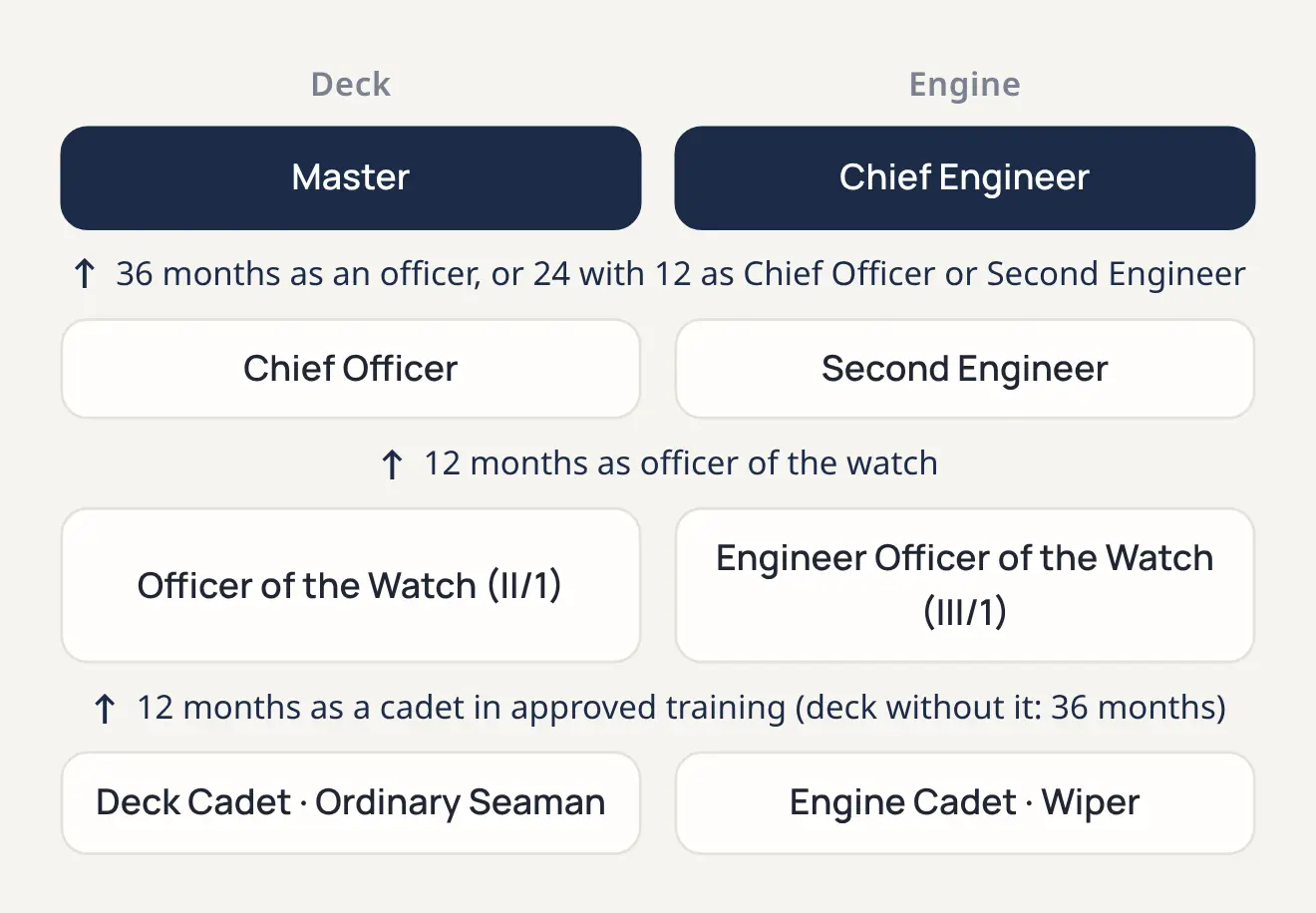
Each step up takes sea service and an exam. Sea service is counted in months of 30 days. The minimums STCW sets for ships of 3000 GT or 3000 kW and more:
- Officer of the watch, deck or engine (II/1, III/1): 12 months at sea in approved training, recorded in a Training Record Book. Without approved training, the deck route asks for 36 months.
- Able Seafarer Deck (II/5): 18 months on deck, or 12 months with approved training. Able Seafarer Engine (III/5): 12 months in the engine room, or 6 months with approved training.
- Chief Officer or Second Engineer: 12 months as officer of the watch.
- Master or Chief Engineer: 36 months as an officer, or 24 months when 12 of them were as Chief Officer or Second Engineer.
Your maritime administration can ask for more than these minimums, and rules change, so check with your administration or school before you apply.
Count the sea service you already have from your contract dates with the sea time calculator.
4. The first CV
On a beginner's CV, what matters most is education, certificates and documents. Give the school, the programme and the years of study, every STCW certificate with its number and expiry, the passport and the seaman's book.
Write sea practice in the sea service part, like a contract: the ship, its type, flag, company, your rank (for example Deck Cadet) and the dates. Do not add experience you do not have: the agency compares it with the seaman's book.
See what a finished CV looks like in the seafarer CV sample, and how to send it to a crewing agency.
Sources: IMO: STCW Convention.
Create CV